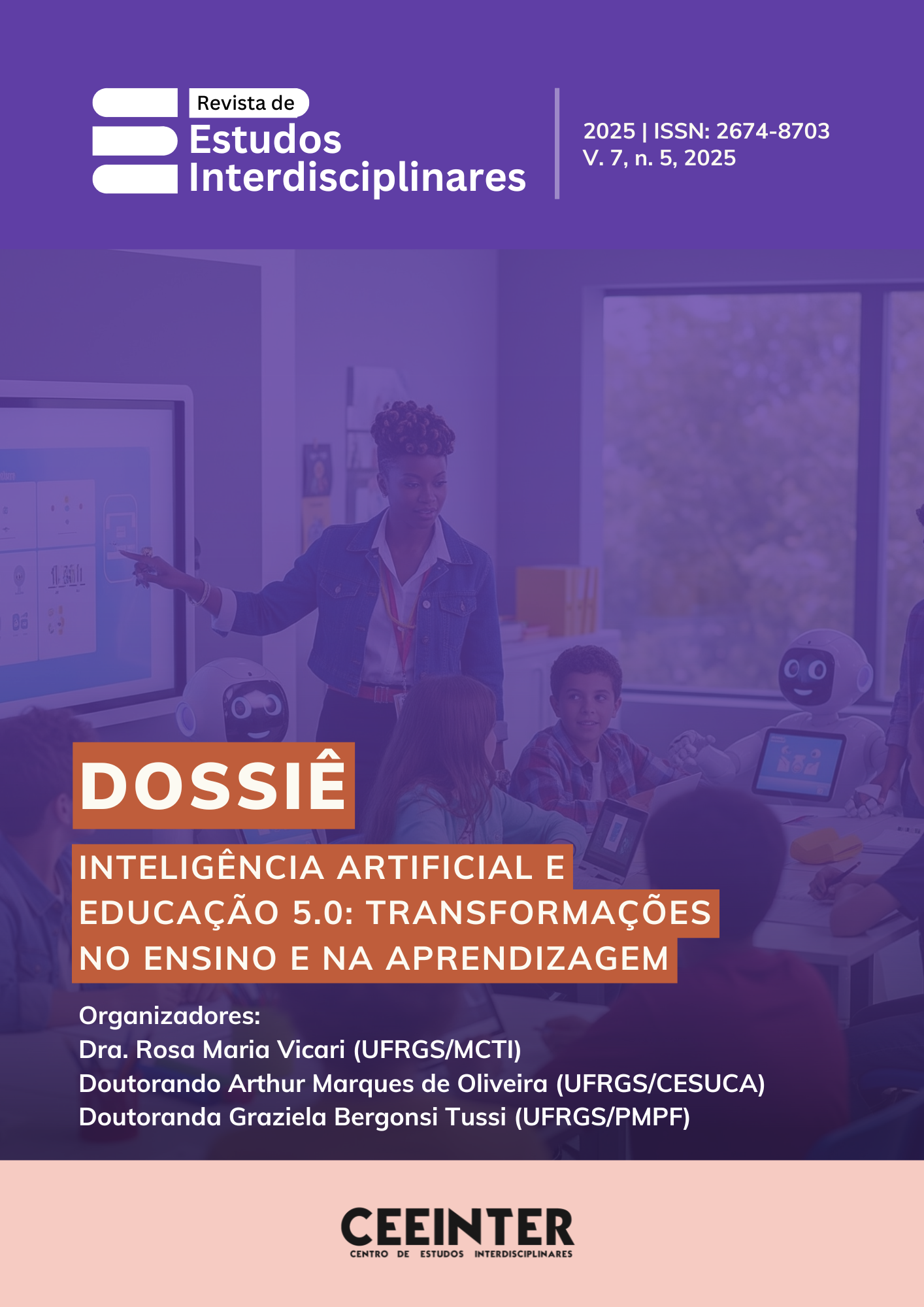
AI IN ACTION
SMART SOLUTIONS FOR REAL-WORLD CHALLENGES
Visualizações: 560DOI:
https://doi.org/10.56579/rei.v7i5.2251Keywords:
AI, Student Autonomy, ICTs, EducationAbstract
Artificial Intelligence (AI) is no longer a vision of the future but a constant presence that shapes the way we live, work, and learn. Its impact on education is profound, as it opens new possibilities for rethinking pedagogical practices and engaging students in more dynamic, collaborative, and meaningful ways. AI is capable of analyzing large volumes of data, personalizing learning, optimizing teachers' time, and preparing students for the challenges of the 21st century by developing skills such as critical thinking and problem-solving. In this context, the project “AI in Action: Smart Solutions for Real-World Challenges” aimed to analyze the potential of Information and Communication Technologies (ICT), with an emphasis on Artificial Intelligence (AI), as a support tool in the teaching and learning process, fostering student agency and promoting the teacher’s role as a facilitator in this process. This qualitative study, exemplified by a Science Fair, demonstrated that the practical application of AI stimulated students' creativity, collaboration, and critical thinking, confirming their engagement and the public’s receptiveness, while also reinforcing the role of AI in assisting teachers and transforming schools into environments of collaboration and innovation.
Downloads
References
CEVALDO, S. e.; SILVA, C. B. da.; LEITE, M. S. O impacto da IA na educação: O caso do ChatGPT e suas implicações para o ensino e aprendizagem. Revista Cairu. Disponível em: https://www.cairu.br/revista/arquivos/artigos/20242_2/08_O_IMPACTO_DA_IA_EDUCACAO_CASO.pdf. Acesso em: 24 maio 2025.
GIL, A. C. Métodos e técnicas de pesquisa social. 6. ed. São Paulo: Atlas, 2008.
LIMA NETTO, M. S. de. Analisando as potencialidades da inteligência artificial na criação de materiais didáticos para o ensino de Física. Revista do Professor de Física, v. 8, n. 2, p. 41-53, 2024. DOI: https://doi.org/10.26512/rpf.v8i2.52289. DOI: https://doi.org/10.26512/rpf.v8i2.52289
LOBO, A. S. M.; MAIA, L. C. G. O uso das TICs como ferramenta de ensino-aprendizagem no ensino superior. Caderno de Geografia, v. 25, n. 44, p. 16-26, 2015. DOI: https://doi.org/10.5752/P.2318-2962.2015v25n44p16
LÜDKE, M.; ANDRÉ, M. E. D. A. Pesquisa em educação: Abordagens qualitativas. São Paulo: EPU, 1986.
MIRANDA, G. L. Limites e possibilidades das TIC na educação. Sísifo. Revista de Ciências da Educação, n. 3, p. 41-50, 2007.
MORAN, J. M. A educação que desejamos: Novos desafios e como chegar lá. Campinas: Papirus, 2007.
PEREIRA, J. A inteligência artificial e o processo educacional: Desafios e possibilidades na era do ChatGPT. Rubra Cinematográfica, 2023.
POZO, J. I. A sociedade da aprendizagem e o desafio de converter informação em conhecimento. Pátio: Revista Pedagógica, v. 8, n. 31, 2004.
PRODANOV, C. C.; FREITAS, E. C. Métodos e técnicas da pesquisa e do trabalho acadêmico. 2. ed. Novo Hamburgo: Universidade Feevale, 2013.
SELLTIZ, C.; JAHODA, M.; DEUTSCH, M.; COOK, S. W. Métodos de pesquisa nas relações sociais. Trad. São Paulo: Herder, 19.
Downloads
Published
How to Cite
Issue
Section
License
Copyright (c) 2025 Interdisciplinary Studies Journal

This work is licensed under a Creative Commons Attribution 4.0 International License.
The Journal of Interdisciplinary Studies adopts the Creative Commons Attribution 4.0 International License (CC BY 4.0), which allows for sharing and adapting the work, including for commercial purposes, provided proper attribution is given and the original publication in this journal is acknowledged.











 The Creative Commons 4.0 International license allows authors to share their works with flexibility, ensuring copyright while permitting specific uses such as reproduction, distribution, and adaptation, provided that the conditions are met, such as giving credit to the original author.